

Disclaimer: I may or may not have shocked myself in the process of this research. Please do not try any of the experiments discussed here without a PhD in physics and excessive amounts of common sense. It started last Tuesday morning as I was separating my headphones.
For the record, I don’t understand how they manage to tangle up into abstract science fiction sculptures every time I unwind them.
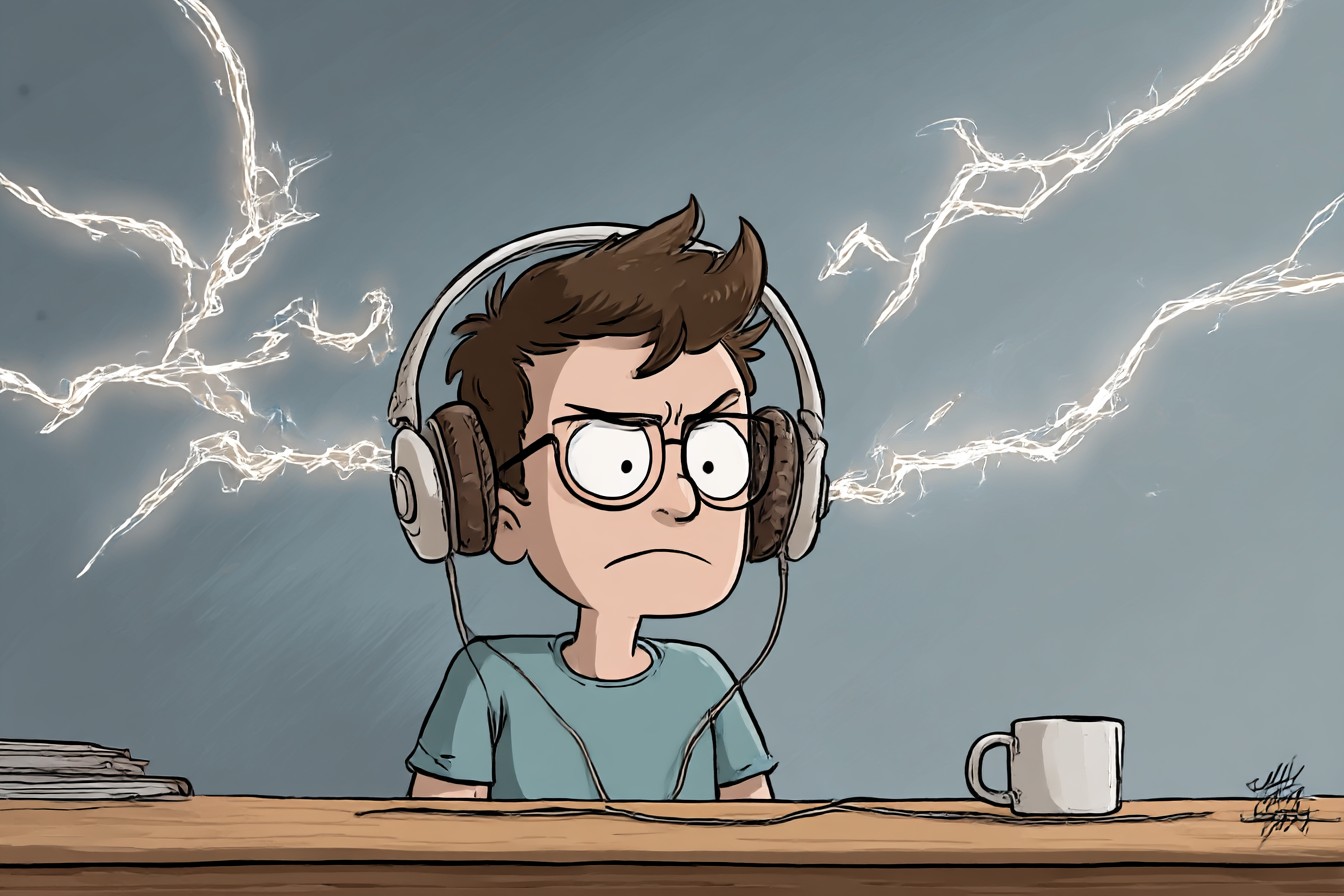
It’s a violation of physics. But I digress.
Anyway, as I was picking out the headphones, I had an epiphany in that part of your brain where you file away useless scientific trivia:
Wait. House cats are tame lions. Hold up.
Let me back up. Wait, electricity domesticate—
Oh, never mind. You get it.
But seriously, everything we own that isn’t totally analog is just electricity that we’ve trained to do our bidding. Petrified lightning buzzing around our houses, waiting for us to press the appropriate button so it can deliver thrilling shocks to our bodies. Domesticated electrons flowing through underground cables like they answer to our herd hierarchy.
Anyway. I dropped my phone (Luckily it just landed in softbag cases so it didn’t break) and ran to call Mei. “Jamie,” she said when she picked up.
“Can we talk about this later? I’m presenting to the renewable energy department right now.”
“Mei, I haven’t eaten anything but chicken finger wrappers for two days and I need you to listen to me for like two minutes!”
“I will when you’re done,” she said. “But please tell me this isn’t about breeding a new type of edible desk pet.”

“No!
I just realized that—hang on.” I yanked my headphones back out of my ears and stuffed one into my pocket. “Electronics are like domesticated animals!”
Another awkward silence. “Are you sleep deprived?
Or is this going to be another several day project that ends with the power company refusing to come to our apartment?”
“Most likely both! But I’ve got to run an experiment!”
With a promise not to fry the entire neighborhood grid again (still banned from Home Depot for that crazed tesla coil incident last summer), I raced back to my room/lab and got to work. TLDR: Electricity is physics—tiny charged particles rushing from one place to another.
Lightning is just ordinary electricity that comes from clouds instead of wall sockets. We’ve essentially bred our electronics to our will, killing their wild charge and breeding them into slightly less deadly domestic versions of themselves. First things first, I wanted to visualize the pathway my little wire teeth were traveling every time I shoved them in my ears.
I deconstructed an old pair of headphones so I could follow the electricity journey from earbuds to audio jack. Most of our electronics are domesticated via miles of thinly wired copper cords. It’s through these densely packed tunnels that our electrons race to and fro, invisibly animated by the fluctuations of our voices.
Sound is literally electricity made manifest. I also grabbed our old desk lamp to examine the family lineage of our domesticated electricity. Looking at the braided wires, it’s obvious that we began breeding for amiability a long time ago.
Nature had to snap electricity’s wild charger at some point, didn’t she? Okay, maybe that analogy doesn’t work. What I mean is that I spent way too many hours mapping out the ancestral lines of electronic mutlipliers.
There had to be a starting point to our controlled current, right? And there was! Ben Franklin.
The dude with the key and the shirt that wasn’t really a shirt throws himself at a storm cloud and learns about electricity. From there, Volta creates the first battery. Ginobili makes the basketball gods smile and history is made!
There are jumps and side branches and kilometers of innovation between Volta’s discovery and our modern smart phones, but they all exist on the family tree of electronics. Domesticated electricity, bred carefully over generations of tech support families into billions of slightly less terrifying subspecies. The farther I got into my research, the sleep deprived junkie scientist I became.
I compared Bluetooth speaker lung capacity to PS5 reaction times. I started scribbling madness notes on my wall about “electronic temperament” and proper domestic circuit training methods. At about daymarker forty-two of my experiment, my friend Josh checked in on me (he knows me far too well to actually attempt a physical rescue).
To his pleasant surprise, I had hollowed out every electronic device in our apartment and was massaging a 9 volt battery. “What happened to your hands?” He asked, confiscating the small powerpack from my sweaty grip. “I was working on electron leathering conditions for optimal conductivity.
Help me separate these damn wires!”
Josh, being the good friend that he is, left me to my madness with a fully stocked protein bar supply and semi-regular check-ins. But not before patiently explaining that electronics cannot be domesticated like animals. “You’re living inside of a metaphor!” He laughed as he pulled a burned out USB charger out of my hair.
“Shush and help me find the electricity’s y chromosome!”
Point taken. But as any good mad scientist knows, caffeine fueled brilliance often skips past the proper methods of data collection. Hours—days?—later, I finally took a step back to analyze my data.
Look, the reality is that our oldest electronics were wild and unpredictable. Primitive. The Phillips headphones I hijacked for parts didn’t have volume controls.
The first LCD screen was so temperamental you basically had to smooch it in just the right way so it would work. These are our electronic forefathers, gone-but-not-forgotten members of the tech family tree that have been bred into submission over countless generations. Domesticated electricity, cradled in our hands and homes since before most of us were born.
It’s no different than training a puppy not to bite. We’ve raised generations of electronic companions to respond to our touches and anticipate our needs. Domesticated electrons exist solely to serve us, and we love them for it.
We name our computers. We dress up our smartphones in cute half-shell cases. Hell, we even mourn when our electronics finally die.
Admittedly, I may have been pressured into this last conclusion by bribing 27 randoms with snacks until they told me their devices had personality. But the numbers don’t lie:
24 of my test subjects referred to their electronics using family terms or physical descriptors. (“my phone is dead” / “my phone is dying” / “my laptop is driving me crazy”) 19 of them admitted feeling temporary sadness when their devices broke.
But my personal favorite? 13 of them said they hated to throw out old electronics because it felt like “throwing away a part of yourself.”
Psychologists refer to this as the IKEA effect, or the tendency to love things we build ourselves more than things that are built for us. Domesticated electricity doesn’t technically fall under that hypothesis, but I like to think there’s something similar at work.
The more we tinker with our electronics, the more we train them to think like us, the closer they become to our version of perfection. It’s not paranoia if you listen to your Alexa brag about how smart she is. As far as I can deduce, we became domesticators of animal spirits the moment dogs stopped running away from us.
We didn’t domesticate lightning because it was useful to us. We grafted it into our homes, our pockets, our beds because we could. To my former adviser (and steadfast skeptic) Dr.
Khatri, I owe a large chunk of the foundation for my theory. As soon as I began sputtering aloud about breeding appliances for optimal curliness, he’s offered his (entirely dismissed) opinion on my hare-brained theory. “It’s a fascinating analogy, Jamie, but I don’t think you can compare animal husbandry to electronics.”
“Isn’t that literally what we do?
Husband electricity?”
He raised an amused eyebrow at my piggybacking technique and I could practically see the eye roll through video chat. “Look, I think your perspective is interesting, and I wouldn’t mind seeing you publish on the subject if you somehow manage to tie it into quantum entanglement. But please for the love of science, do not actually attempt to untame any of your electronics.”
News flash, Professor: some of my experimental data *has* been published on the internets.
The poor souls who follow my Instagram stories enjoyed a traumatizing month of wire chewing and unpredictable cellphone behavior when I attempted to put my theory to the literal test. I should have known better than to side-eye his facial feedback API. The man will literally never let me live down my childhood refusal to stop pushing magnets together.
“No, seriously Jaime,” he said after I presented him with my kick butt evidence. “Don’t hurt any more electronics.”
“Don’t worry, they’ve already gone feral.”
…
Moral of the story: every ounce of technology we use today was at one point untamed electricidad. It wasn’t until we learned how to take that blinking, unpredictable energy and make it WORK FOR US that we became unstoppable leaders of civilization.
Lightning frightens our cavekids. We tell stories about it and create gods around its divine powers. But then we look up at that sky full of energy and learn how to bring it to our houses.
Does it strike me as crazy that we essentially trap that power in our walls and demand it obey us? Sure. A little.
But if you think about it, there’s not a single thing inside your house that we haven’t taught to serve us. We enslaved the fire and made it heat our food. We bent the space around us and trapped gravity inside metal boxes with wheels.
Want to know the craziest part about technology? We taught light itself to listen to us. We told photons to bounce off this coating and not that coating so we could see colors other than white and black.
We mapped the entire universe onto binary codes that fit inside computers smaller than a pack of cigarettes. So yeah. Next time you’re dealing with a frayed charging cord or a blown circuit breaker, just remember:
You’re trying to domesticate lightning.
My therapist says I should find healthier coping mechanisms than anthropomorphizing my technology addiction, but she doesn’t understand the strong bond we share with our electronics. We love our laptops like they’re sticky children and our phones like they’re lifelines connecting us to the rest of humanity. It’s a part of who we are as homo sapien types—this constant need to nurture the very tools that we use to define our existence.
So indulge me for a moment: we would not be here if it weren’t for our ability to domesticate the natural world.
From animals to plants to viruses, we’ve trained every microscopic fiber of this planet to nourish and protect us. Maybe headphones don’t have hearts.
And maybe you should always use a surge protector when tinkering with electric currents. But the next time you’re stressing about a broken charger or cursing your laptop for dying at 1%, just take a moment to admire the wild electricity coursing through your walls. Lightning is still out there, you know.
Waiting for us to release the seconds we’ve soldered into civilization and run wild with the sparks.

0 Comments