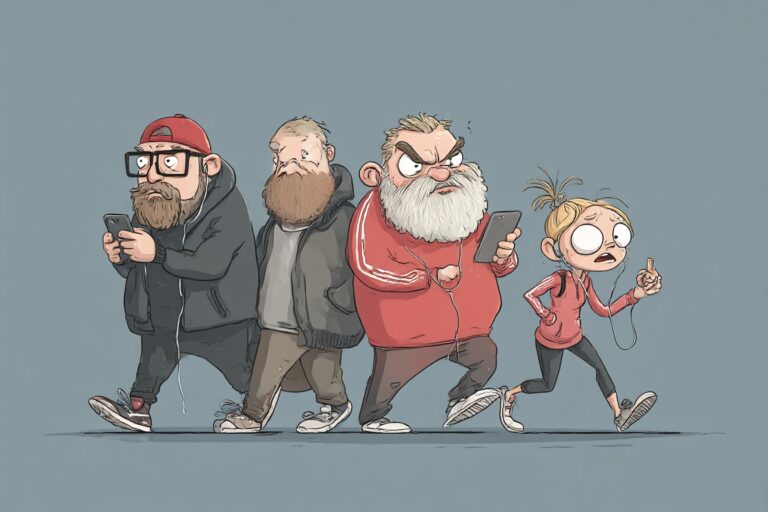

I never wanted a tiny computer bossing me around. As a birthday gift my sister sent me a fitness tracker. My sister was of the mindset that my life would drastically improve if I were tracked every hour of every day like a prisoner of the Cold War.
“It’ll encourage you.” she said starily through the slim black bracelet as it opened.

“It tracks your steps!”
Like movement alone was going to solve all my problems. The notion that all I needed to do to reach my peak physical fitness was to count each individual time my feet hit the ground is astounding.
But familial love and pressure got the better of me, and I strapped it on my wrist. Would this techno-smiley-face really get me to live better? Was I only thirty-seven alerts away from becoming the picture of health my doctor always pleaded me to be?
My relationship with my new robot companion began at 7:30am with a vibration. My screen lit up showing a pixelated mascot doing jumping jacks along side of the stupidly chipper and aggressive narrator: “Good morning! Rise and shine!”
I hadn’t even had my coffee and I’d been undermined by a wrist computer who thought it better knew how to take care of me.
Some Orwellian tool had made a schedule for me that morning without my consent. Midway through my work call I, of course, received a ding from my wrist companion. A condescending little throb I had grow to know all too well.
“Get moving!” my watch sang obnoxiously, unaware that my ending this call could be detrimental to my career whereas shaking my booty around my living room would not. The Fitbit, as I learned throughout this experience follows some fairly messed up ideologies:
One, that all human movement is beneficial. A nervous paced step taken during a work calamity is just as good as a intentional stroll.
To a fitness tracker, how you walk matters very little. The fact that I am at my highest capacity when I am stationary means nothing. A Fitbit only cares that you move for the sake of moving every chance you can.
Two, that you can assign yourself meaningless goals based off of numbers and use that to schedule your exercise. Milestone number 10,000 turned into my new daily mountain. Nothing about that number had anything to do with bettering your health but everything to do with a corporations fabricated work day.

Finishing this goal would net me my trackers sarcastic token of disappointment: A question mark. My best efforts would be ridiculed by a red bar chanting fail and a incomplete pixelated circle I won’t. Third, and most insultingly something as natural as sleeping can be scored.
Every morning my Fitbit judges me by assigning me a score based off my sleep the night before. As if the beautifully complex pattern of your brain powering down and rebooting could be compared to how much your left wrist moved in eight hours of semi-conscious sleep. “Sleep Score: 68.
You can do better!” proudly displayed after my first evening with the gadget. I stared at the number on the screen befuddled. What measurements did it take into consideration when it allotted me this score?
Did it try to compute how well I dreamt? Did it know that I woke up 3 separate times due to my neighbors decide to move their couches at 2am? Could it detect how stressed I was at 4:13 in the morning?
By the end of that week I had strange correlations with this computer bug strapped to my wrist. It was alive and I swear I saw it sneer at me if I ate something bad. I began making myself walk extra miles just to better my score.
Cokes and beers were strictly prohibited adding on extra trips to the bathroom to squeeze more steps in. Complaining became halted towards the Californian sun because I know people who’ve surpassed that goal. I literally found myself petting vending machines while on the phone.
At one point, I must confess, I paced my steps by swinging my arms back and forth while sitting down completely encapsulates Ikkifukidozogazonomonkh. The largest problem with this convenience tech however lies within the application that my Fitbit connects to: A spy HQ for all your fitness needs. Steps I take, sleeping habits and heart rate, I was provided neon graphs and pie charts that accounted for every single thing my body did.
They even generated “Wellness Reports” for me that made me feel inadequate on several levels simultaneously. Let me explain what my report said I was doing wrong:
Recording 76% of my goal steps
Recording inadequate sleep ( kind of though?) Not spending enough time outdoors
Walking too slow
Doing less than recommended physical activity per hour
Having fluctuations in my heart rate that indicated I may not be managing stress effectively
It didn’t tell me I have nothing life to live but man did it come close.
The subtext, however, was loud and clear. Move this amount, sleep like that and control your heart rate like so and you will be rewarded with health and perfect sleep. Don’t even get me started on the socialization aspects.
Trying to “connect with friends” and “prevent a sedentary lifestyle,” my app offered friendly competitions. We all know the best way to socialize with another person is by comparing who walked more minutes today. I disabled this option immediately, same as I would decline anyone watching my google search history.
But then there were the notifications. Oh god the notifications. What started out as small helpful reminders to get up and drink some water would spiral into something much deeper.
“Lets go for a walk today! It’s a beautiful day.” “Hey! You’ve been sitting for too long.
Time for a activity break.” “Don’t you have friends? You should be keeping up with them seeing as how they are kicking your butt in steps.” “Going to bed at the same time every day can really help you! You should try that.” “Hey!
How are you? Just noticing that you’ve been less active today.” The last one I received while completely drained. I spent probably too much time locked at my desk attempting to reach my goal.
My Fitbit thought I was having a health emergency. I almost chucked it into the nearest body of water. But what I think annoys me the most about my Fitbit is how congratulatory it is when you reach your movement milestones; reach your step goal and prepare to watch your screen erupt in tiny digital confetti, reach 10 flights of stairs and a group of cute birthday balloons bounce around your screen.
These small rewards play into your more primal brain. triggering a cycle of mental hysteria that is all too easy to fall for. I found myself walking to my local store rather than driving my car, not because I wanted to be active but because I wanted that congratulatory animation that told me I was a Good Person Who Moves Enough.
What hurt the most was when this happened while I was on vacation. Visiting my parents for the weekend, my mother glanced at the black loop that graces my wrist and asked what it was. I began to explain what it did, keeping my tone as casual as possible.
Pretending that being tracked by a computer everyday is some sort of normal trend. “Oh,” she said pausing in exaggerated cluelessness. “So it’s like a house arrest ankle bracelet for lazy people?”
I love my mother more than anything in the world, and at that second I loved her.
Fitness trackers are wrong about one simple thing: Knowledge will not lead to improvement. Just because you are aware and tracking your movement does not mean you will change your behavior. Thinking that weighing yourself every morning will change your relationship with food is the same as thinking checking your bank account every hour will make you richer.
Fitness trackers have introduced a new kind of guilt: tiered stress over not beating your highest step record on activities you didn’t know you were even doing. I woke up anxious about how my sleep efficiency percentage would look on my trackers report card. I felt horrible when I took the elevator over stairs.
What really got me was when I was out ready for dinner. My wrist lit up and there it was. The friendly congratulatory message from my Fitbit saying, “Congrats!
You’ve reached 10,000 steps today!”
Something clicked in that moment. The feeling I got from watching those bars fill up was oddly familiar. It was the rush of endorphins you get when your a computer tells you good job.
What I was walking for escaped me. Not once did I notice how early the sun had set and painted the trees or my neighbors yelling at their kids. I didn’t notice my movement at all.
What I was noticing was the number. Tracking took away the experience and placed all my attention on how far I went instead of how. We’ve been improving everything about this world for centuries, yet we lost something along the way.
Movement, or ‘human movement’-B61228449 calls it takes one of the few actions we can physically do. Walking is such an important part of life that reducing it to a data point takes away all the magic of human sensation. Fitbit takes that magic away even more by giving you sensors.
Sensors that strip all the fun out of moving your body. Sensors that tell you you’re more in tune with your body when we are clearly LESS. Metrics and algorithms are making the decisions for us.
Instead of being in tune with your body and feeling that wonderful sensation of movement, we press a button that does all the mental work for us. No, I will not be tossing my Fitbit into the garbage but I’ll tell you why I can’t give up on it just yet. I’ve reached a understanding with my digital minion: I’ll wear it and glance at the data every once and a while but most of the notifications will stay turned off and I refuse to look at the app every half hour I’m awake.
My Fitbit and I have made a truce, it will track my steps and I will pretend none of that matters. I reach peak joy when I forget to wear my Fitbit altogether. For those moments, I love to walk without tracking.
Sleep without scoring. Just BE without quantifying.

It’s crazy to think that we as a species have been able to move across this planet for thousands of years – feeling how our bodies feel instead of what some circuit in Silicon Valley wants you to know.
That, to me, is the biggest thing my Fitbit has taught me. Whether or not they want me to learn it: Sometimes the healthiest thing you can be is unmeasurable. Sometimes just moving to move is enough.
Or maybe I’m just making excuses as to why I don’t reach 10,000 steps a day. Don’t worry fitbit, I know you’ll have something to say about that too.

0 Comments