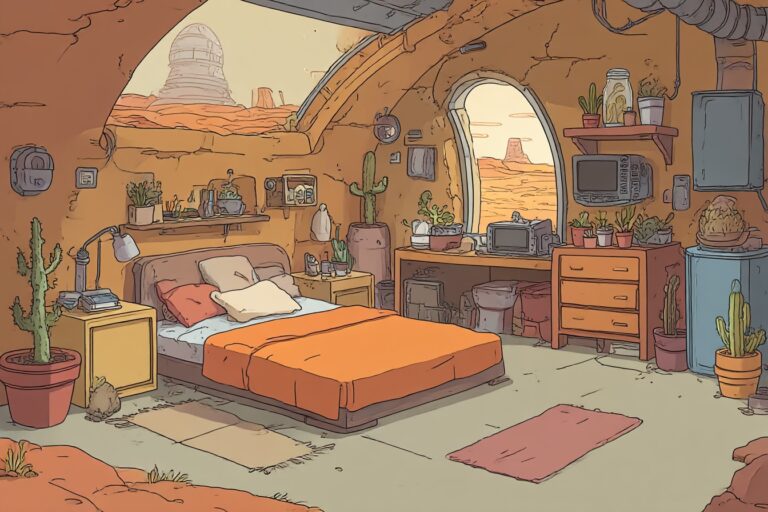

I think the first time I ever paid attention to resource management was when my buddy Josh coaxed me into playing Terraforming Mars one night during our bi-weekly “games that let you feel intellectually superior to others” session. When he picked me up five hours later (courtesy of his), I was surrounded by plastic trees and shaking too hard from caffeine to place another heat mat without toppling my opponents’ cities into the sea. It was during those final moments, as I placed my last building and grabbed some off-brand fake crab legs before driving home, that I had the breakthrough idea that eventually led to what Mei now lovingly calls “The Great Clean-up of 2021.”
Okay, hear me out.
Organizing your bedroom isn’t really the same thing as terraforming an entire planet.

But the concepts were similar enough that when I actually sat down and thought about how to systemize cleaning my room, what I learned from Terraforming Mars really helped. It all started like any other scientific tragedy.
My research on bacterial signaling had reached peak-hoarding phase. You know the phase. The phase where stacks of papers and notebooks overflow off your desk onto every horizontal surface within a three-foot radius.
Where “just in case I need to refer back to this rambling brain dump about lipid membranes later” becomes its own category of literature. The organic spillage of science had reached sentience. Mei had given up.
At first when I brought my experiments into bed with me (literally. Temperature fluctuations are terrible for cultures. ), she would carefully skirt around them on her side of the room.
She’d jokingly threaten to start charging me rent if I ever left any glassware on her nightstand. But she came home from work one day to find me inching across the floor on my hands and knees, digging through a towering pile of notebooks to find the one where I wrote down a three-week worth of observations. She wasn’t mad, per sé.
She just asked me how much longer it would take before everything I owned swallowed me whole. “It can’t keep being like this, Jamie.” She knew better than to say science, because that was never something I could justify putting first. “You’re right.” The physicist in her had spoken.
My bedroom was careening toward heat death. The next Saturday, Josh dropped off a pile of board games so we could unwind from our weeks (he had no idea). “You should take a break from stressing about all those phosphorylating phosphorylases for a little while,” he told me as I readied Terraforming Mars on our dining table after he’d cleared it of its perfectly justified science journals.
Hours, and many billions of tones of theoretically placed Martian CO₂ later, I had come to two realizations. One, fuck Terraforming Mars and its merciless variable sprawl. Two, my strategic thinking was miles ahead of my organizational skills.
By mid-game I was hyper-focused on how much oxygen I was producing each round. By the end of game I was quietly calculating how many heat mats I could fit onto my tableau if I played my cards right. “You play this way you do science, you know that?” Josh laughed as I placed my fourth forest tile on a plot of land he had been scheming to claim for nearly three turns.
“No, what do I do?” I countered, mostly just to stall while I figured out how to not be completely robbed. He shrugged. “All manic rushes of productivity followed by months where you can’t do anything because you haven’t built infrastructure.”
That clicked something in my brain.
I built terraforming corporations in exponential growth patterns because I was damn good at it. So why didn’t I organize my room the same way? If anything my bed sheets were worse terraformed than my actual bedroom.
When I woke up the next morning, sunlight beaming across my rapidly fossilizing collection of belongings, it hit me: what if I treated my room like Mars? Before I could start cleaning I needed data. In true scientist form, I procrastinated cleaning by taking exhaustive inventory of my junk.
I counted every single belonging I had that didn’t have a home, every drawer I couldn’t open without spilledTrash falling on my head. I made color-coded maps detailing the topology of my blankets. My opening statement: I had somewhere between 542 and 625 individual objects with no designated home and my available surface area was being used at approximately 92%.
If I was going to successfully terraform my room I needed to think like I did during game rounds. I needed resources, production, and production efficiency. In game terms I had been trying to spend all my cards each turn without even building the foundation of an engine.
Bedding terms: I had been hoarding and creating without putting any thought into where the ‘byproducts’ of my science were going. So first I decided I would look at my production. Literally.
I calculated exactly how many papers went onto my floor versus how many notes I would take each day. What was the turnover rate of a single experiment, from start to finished notebooks? The results were….interesting.
To maintain my current level of chaotic science, I was creating research material at a rate of roughly 3.5:1. “That’s great.” Mei laughed when I presented her with my findings. “but how does that help you clean your room?”
Oh yeah.
Terraforming. Mars. Players of Terraforming Mars learn fairly quickly that you need engines to produce you cards (resources) each round.
You need ways to turn one resource into another. And you want ideally to build those engines before you even need what they produce. I needed to engineer my room.
The first thing I did was address my influx of resources. In game terms I needed to look at my production. How many new cards did I realistically gain each round?
And could I convert some of those cards into something I wanted through one of my engines? Applied to cleaning, I took a hard look at how many papers I was even allowing onto my floor each day. What was coming in, and what was I doing with it?
The numbers were bleak. I allowed myself to acquire new papers at nearly four times the rate I was processing my current mess. “So what are you going to do about it?” Mei asked, eyebrow raised in that way that told me she was about to make me put my game-plan into action.
“What I normally would do is build systems to clean up after myself. Only instead of hoping I have the cards I need each round to run my assemblies, I want to make sure I have the infrastructure in place to tidy as I go.”
She rolled her eyes, but I could tell she was listening. “Okay, smart dude.
So what does your first step look like?”
“Tile placement.” I said immediately. One of the earliest lessons you learn when playing Terraforming Mars is that where you place your tiles matters. Not only do you get bonuses for placing them near each other, but you own those territories and can place cities later for even more points.
Bedsheets, obviously, were non-negotiable. But what if I sectioned off my room into different zones? A station for current projects, a place to sort through new papers, assembly line for printing?
And *(*cough*MEG*Cough*)*most importantly, an actual area to sleep in that wasn’t covered in microscopes. From there I started breaking down my belongings into resource types. Paper = resource.
Books = resources. Trash = also resources, but you know, garbage resources. Every item that came into my room had to earn its keep.
Did I need a physical copy of this journal on my desk? If I was reading a new book, where was the designated spot it would live once I was done with it? Did I even finish books this slowly?
It took me weeks. There were many mistakes. I TRIED TO Dry Erase The Bed into my organizational system and it did not end well.
I came super close to tossing half my journals in a fit of jealous rage one sleepless night. But slowly, with patience and horrifying amounts of sweat equity, my bedroom started to change. About three weeks into my project, Mei walked into our room and actually gasped.
“There’s floor!” She exclaimed, as if she had just discovered a new element. “And you can walk from one side to another without jumping over piles of stuff!”
I wanted to brag. Instead I gestured her over to my spreadsheet.
“See, by building systems to clean as I went I could ensure that any new resource I acquired had an assembly line it had to travel through, with maximum thresholds for how long it could stay in one place.”
She stared at me. “Did you honestly use Mars to convince yourself you were becoming an adult?”
Honestly? Yeah.
But it’s also not that far off. Management of your environment, whether it’s a planet or your bedroom, works on similar principles. Input > Process > Output.
Resource > Production > Acquisition. Without systems to manage your flows nothing can grow, even if that growth is just shoving more crap onto your desk. What I love most about my new system isn’t even that I can see the floor.
It’s that I’m actually getting more done. Sure, layering my process with quality control checkpoints and color coded TODOs sucked at first.
But having actual systems in place to manage my scientific frenzy has made me about 27% more efficient (numbers pulled from my scrupulous tracking).
Who knew cleaning actually made you better at science? Okay, fine more than that. The thing I hate most about my system is I still haven’t been able to figure out how to manage heat production.
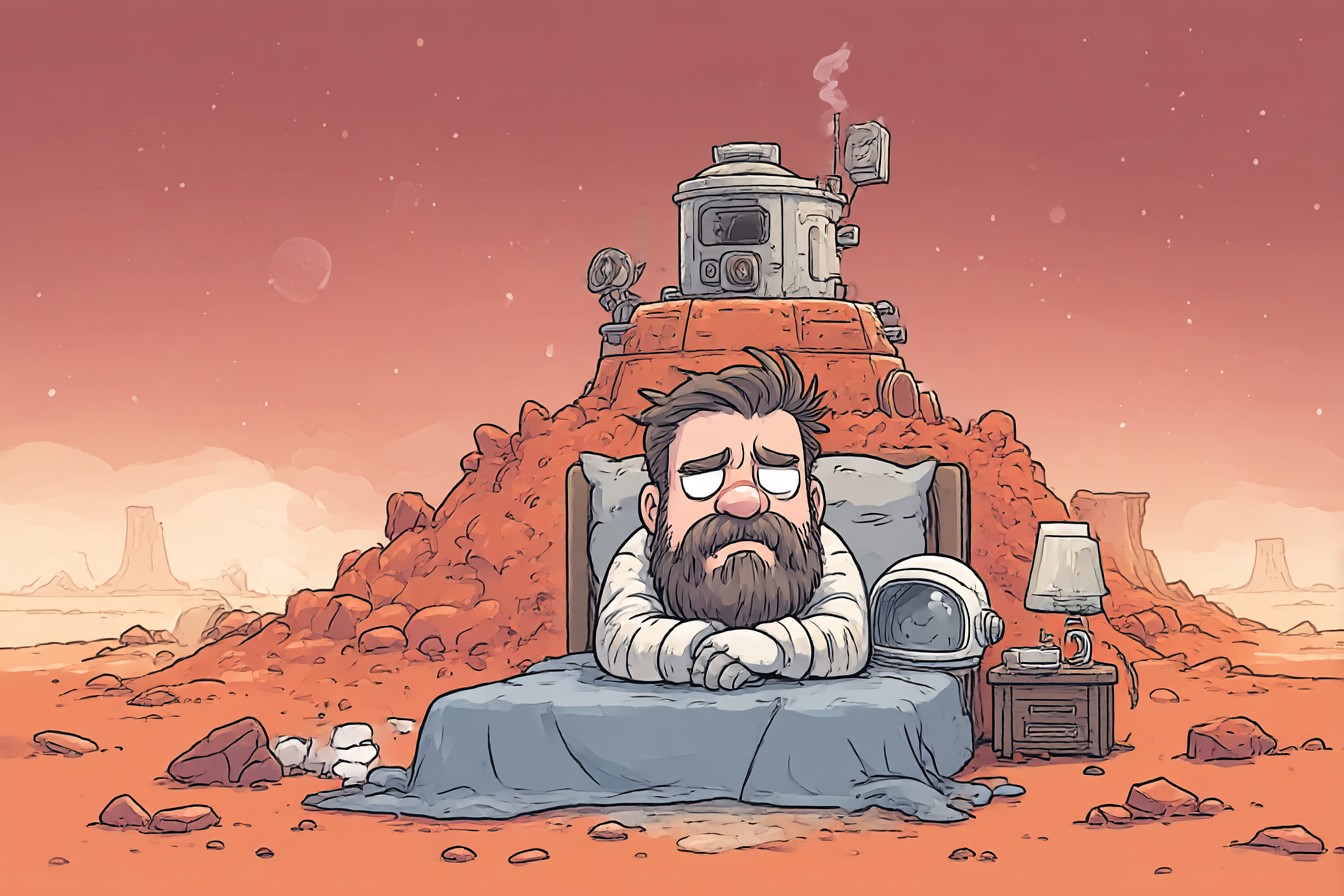
According to Mei, sleeping next to three laptops does not actually constitute optimal sleeping temperatures. Some problems just can’t be terraformed.

0 Comments