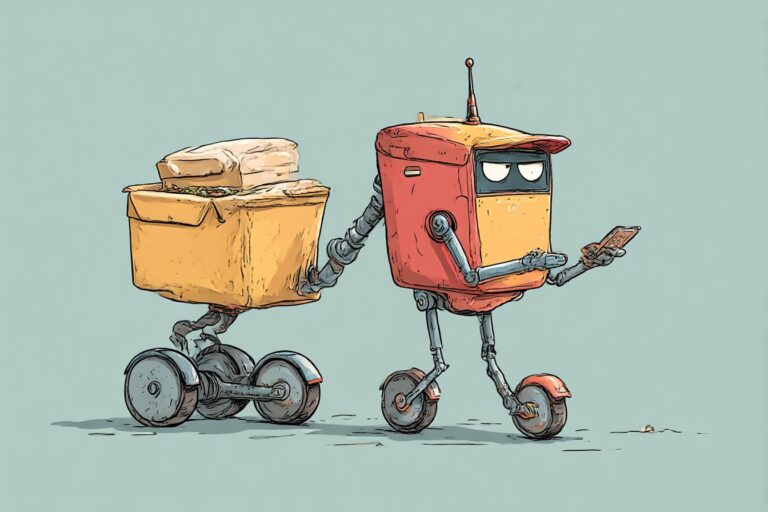

Last Tuesday I was walking home from the shops when I nearly tripped over something on wheels. It looked vaguely like a cooler bag on steroids. The box-shaped thing was waddling slowly down the pavement, humming quietly like my Hoover.
There was a little flag poking out of the top proclaiming cheerfully that there was lunch inside.

“Excuse me”, I said automatically. Then noticed I was apologising to a robot.
Naturally, it gave no reply. It sat there imperiously on the pavement, its wheels straddling the white paint like muscular legs on strike. Obviously confused by my insolence, it stared.
I stared back. Neither of us was backing down. I’m no pavement grandma – I hate confronting appliances.
But if ever a robot was going to get me narked it was this one. Eventually, I had to dodge into the road to pass it. Rush hour road, I might add.
Two feet away from oncoming traffic I glared at the machine as it lumbered obliviously past me. In that moment, I realised what we have all been wondering: who thought this was a good idea? Robots like the one that almost got me killed roam our streets delivering meals.
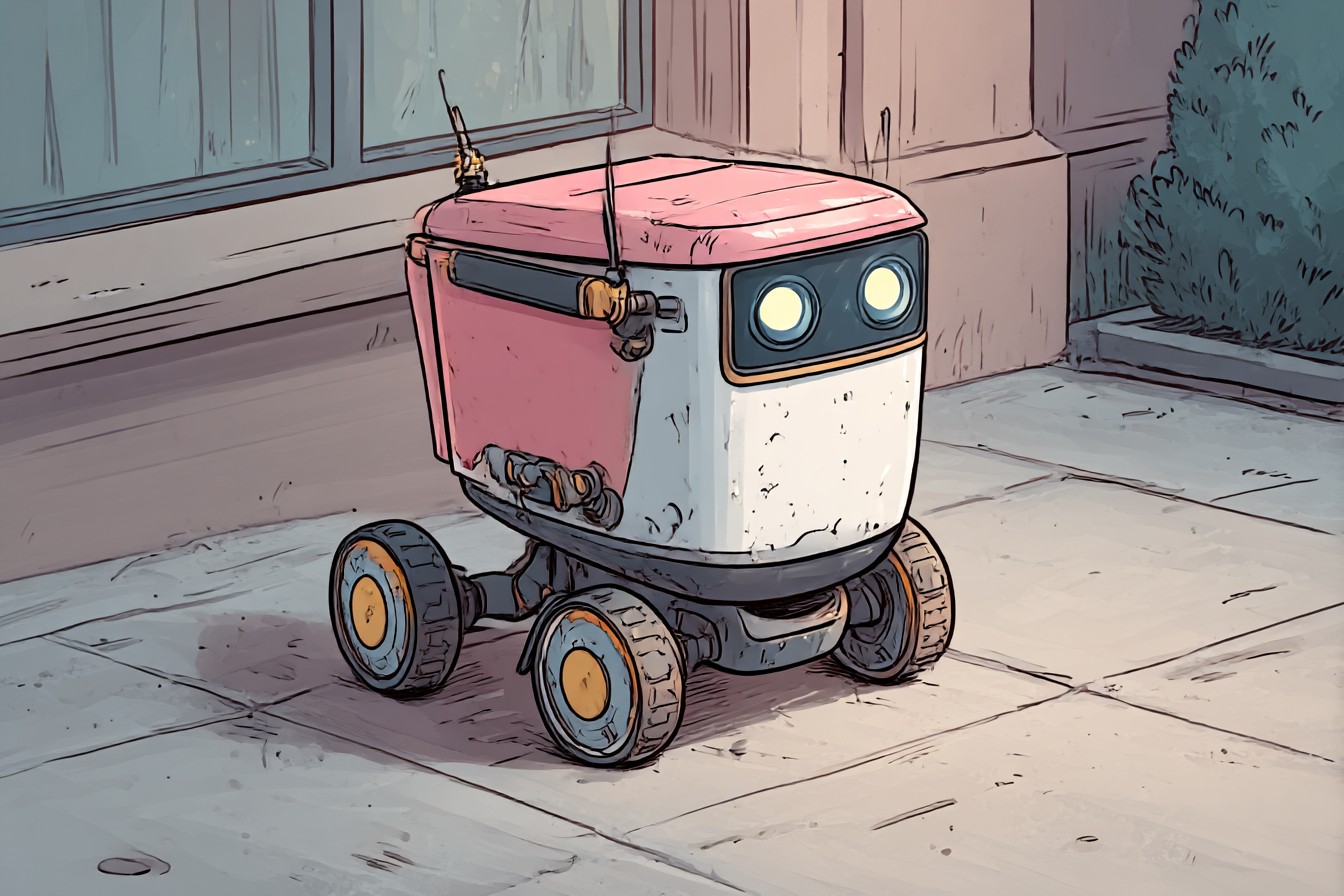
They’re boxy and humanoid, usually adorned with flags proclaiming either the tech company responsible or enticing you to buy a certain restaurant’s curries. They use clunky six wheels and usually come in white or a primary colour that says “look at me! I’m from the future!” Some honk cheerily to alert pedestrians as they trundle towards you at walking pace.
They’re supposed to use sensors to avoid bumping into pedestrians, lamp posts, cars parked on the pavement, or pretty much anything else that might get in their way. I use the word “supposed” liberally there because – based on what happened to me and several videos on social media – these robots have about as much spatial awareness as Stephen Bull*
(*Former Deputy Head of News at Sky News. Bad driver.)
Robot delivery is the future that one of my friends who works in tech is perilously close to having sex with at the slightest provocation. Like many people who work in tech, he’s rather fond of robots. When I jokingly complained about mine his eyes lit up.
“These machines are the future of last-mile delivery!” he exclaimed over several beers last Friday. “They’re environmentally friendly, they don’t contribute to congestion, and they never sleep! Imagine the possibilities!” he went on daydreaming aloud.

“Like forcing expectant mothers to deliver packages on the roof of a train because a robot decided to park on the pavement?” I said drily. He waved my concerns away as mere “teething problems”. Technological teething problems are what you excuse when new technology causes actual harm to people.
Painful growing pains that must be tolerated! I decided to look into these fantastical “future robots” further after mine nearly killed me on the pavement. What I found was one of those perfect examples of tech “solving” problems that aren’t problems at all, at the expense of creating new problems.
Like… what is the actual problem these robots solve? Efficient-ish food delivery! Great, so food delivery is inefficient?!
Prior to robot deliveries, I could order food through an app on my phone and have a human being bring it to my door in about half an hour. Pretty efficient if you ask me. Robots don’t make this process faster (they’re slower than delivery bikes or mopeds) or cheaper (they’re run by Silicon Valley darling tech start-ups spending millions subsidising every order)…
Except they do make it more “efficient”.
They put a machine where a person used to be. One robot equals one less delivery job. One less job that might have gone to a student earning some money over summer, one less job that might go to an immigrant trying to feed their family.
All to shave seconds off the time it takes for you to get a bag of lukewarm chips delivered to your door? And to solve the monumental problem of robots forcing expectant mothers to enter oncoming traffic? It doesn’t stop there though.
As well as eroding our already fragile social contract by removing paid human work, these robots also cause havoc with our public spaces. Pavements aren’t the private testing grounds of corporations, they’re commons. Commons for pedestrians.
For wheelchair users. Pram pushers. Parents helping toddlers cross the road.
Blind people with guide dogs. Everyone. I called Marion, who is wheelchair user and lives in an area where they’ve been trialled.
“They’re an absolute nightmare,” she said. “They take up the whole bloody pavement. One stopped halfway across the pavement near me and I was forced onto the road.
That’s two organisations expect me to put myself in danger,” she added, referencing another time when she’d contacted their council over the issue. “The council said they’d done nothing wrong because robots are GRANTED PERMISSIONS TO BE ON THE PAVEMENT.”
Yes. Robots are dumping blocks into our public spaces and literally everyone has to fucking accommodate them because they’ve been given permission by bureaucrats who listened to a PowerPoint presentation about the future once.
I saw one wedged at a kerb last week trying to fall over itself to climb the curb. Two kids were attempting to stab it with sticks while the company’s employee hurried over apologising profusely. Ten minutes later, I saw another cause three cars to brake sharply while it tried to cross a busy junction.
Welcome to innovation! Critics of these robots are routinely asked if they are afraid of technology. Sure, question whether robots belong rolling around our streets wielding your bloomin’ lunches.
But you’re a technophobe who hates progress and secretly buys his food from catalogues if you don’t want them making our cities more “efficient”. Let me be clear, I’m not fetishising “old ways”. But just because we can automate something doesn’t mean we should.
It also doesn’t stop companies pitching fucking robots as the answer to society’s ills with zero scrutin y from our so-called representatives. Like tech journalists, big tech likes framing these criticisms as Luddite nostalgia. If you don’t like robots roaming our pavements you’re clearly scared of change, probably still listening to CDs and stockpiling KY Jelly in preparation for the driverless revolution stealing your parking meter job.
The problem isn’t robots, or automation. The problem is people aren’t being consulted about where they’re acceptable and where they’re not. They’re being forced upon us under the banner of inevitability and “capital-I Innovation”.
If you asked most people what problems they’d like technology to solve, streamlining robotic curry delivery would be way down the list. We have a housing crisis. A care crisis.
A climate crisis. But no – please let venture capitalists burn through more money making human work slightly… shittier. My other tech-loving friend Priya works in urban development and had stronger words than me about robot delivery, if you can believe it.
Over brunch she told me; “Public space is already contested as it is. There’s only so much room on the pavement before you start encroaching on someone’s life. Robots on the pavement are theft.
Slow-motion privatisation.”
I’ll leave it there to stew in its own fury. My point is – robots are everywhere we look. Cars dominate our cities.
We’re shoved onto cramped pavements to walk bloody FAST or be accused of laziness. Car companies literally OWN our roads (parking bay charges aside). Autonomous robots are now invading the last bit of city we have that’s reserved for us:
Humans.
I tracked one on a pilgrimage around my neighbourhood last Saturday. I felt slightly ridiculous stalking a refrigerator on wheels. But what happened next only took about five minutes:
-The robot got stuck halfway across a pedestrian crossing, forcing someone to help it on its way
-A couple were completely blocked by it on a narrow stretch of pavement.
The man had to hover partway over the bike lane to pass
-A dog became terrified of it and attempted to mount it like a horsey
-It sat, wheels spinning, for three minutes when confronted with a puddle
Welcome to the future! There’s a pattern here. Tech companies big up a problem that disproportionately affects nobody.
“Robot delivery is quicker than human delivery!” Cue them creating a robot that’s actually slower than human delivery…
They test it on the streets with little to no consent. If someone complains it’s nothing more than ridiculous Luddite nonsense. Repeat until we’re all numb to robots roaming free across our public spaces.
Hell, we’ve already been through this carousel. Electric scooters have made our pavements unusable for pedestrians. Ride hailing apps were supposed to reduce congestion but only increase it while murdering public transport.
Autonomousrobots are just the next bit of corp tech ruining our cities. Of course robots delivering our food won’t KILL anyone. But they will make life more difficult for everyone, and anyone who depends on our public spaces NOT being gridlocked with robot shit will struggle even more than before.
We need to ask ourselves WHERE we want automation. We don’t need cars to drive themselves. We don’t need delivery robots cluttering up our sidewalks.
What we DO need is enough houses. Education. Healthcare.
It doesn’t have to be this way.
Technology could make our cities more humane. Robots could be used to help those who need it most.
My advice? Don’t apologize to robots on the pavement. You’re doing nothing wrong and they couldn’t give a shit anyway.

0 Comments