

It started with a burrito. Josh, my MIT dorm roommate, and I were having one of those midnight disagreements that all MIT students are familiar with—one of us hungry, the other possessing the last item in our shared mini fridge. Both of us had been studying all day; neither of us were prepared to lose what had become a battle of attrition over who ate last night’s Lean Cuisine.
“I paid for it.”
“I haven’t eaten since lunch,” I retorted.
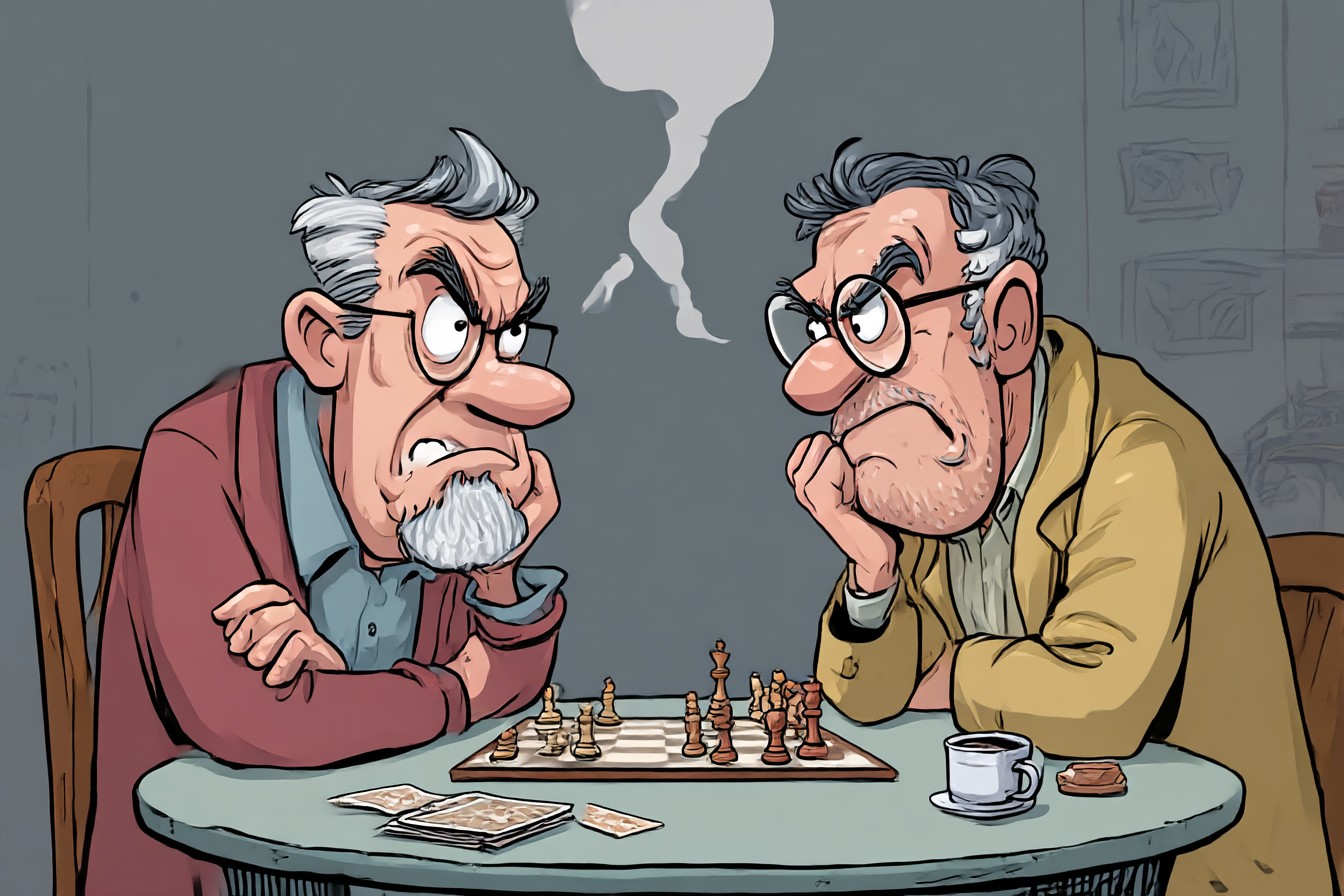
My stomach growled, doing its best to distract me from the calculus I was performing on how many kilojoules it would take to keep my brain from totally shutting down during the next three hours of calculus. This brings me to the next phase of our interaction.
In lieu of continuing to argue or, you know, behave like reasonable adults, we decided—both of us scientists!—to formulate the problem with a mathematical model. Josh grabbed a sheet of paper and began scribbling matrices. “We can model our options here as a game,” he explained half-asleep.
“Our utility functions just need to account for hunger, initial ownership stakes, and social currency.”
I’ll admit, I was impressed. He spent the next twenty minutes reducing what started as a perfectly reasonable argument about equity into a quantifiable game theory decision tree. By the time we’d solved our model, we had determined that the best course of action was to split the burrito unevenly in my favor and trade me some of my coffee privileges tomorrow for his silence.
The burrito was gross. The experience was life-changing. Okay, before we go any further, let me just back up and say that people and their behaviors have always fascinated me.
During undergrad, my psychology electives probably took up nearly as much brain space as my biochemistry major. The issue was that traditional psychology seemed stuck in qualitative land. Yes, you could describe human behavior in painstaking detail, but how could you actually predict it?
Game theory changed that. For the first time, I felt like I could use numbers to analyze people. Alright, quick refresher if game theory is, ahem,Game Theory game: GT is the study of mathematical models of strategic decision-making.
Players make choices that they think will benefit them based on what they think other players will do. It sounds simple. Hell, it is simple.
But when you start breaking down human behavior into equations and choices, it opens up a world of possibilities. I spent the rest of that night cycling through potential models of every situation I could think of. Should I shower before or after Josh?

Did game theory explain how online dating worked? What about the free rider problem with our room cleaning? Josh was dumbfounded.
“Dude, people aren’t rational,” he’d complain after watching me incorrectly predict the outcome of some social interaction. But that was the exciting part! Human behavior deviated from rational decision-making all the time.
Those discrepancies could teach us about what really drove people to make the choices they did. If everyone knew the odds of cheating on a partner but still did it anyway, there had to be an underlying benefit to the behavior that my models weren’t accounting for. Case in point: my first real social experiment.
I was taking Organic Chemistry that semester, and there was this one group project. Four capable students who could have easily aced the assignment together somehow managed to turn in a product worse than each of us would have been able to do individually. It was a classic tragedy of the commons scenario, so for the following assignment, I proposed a rationing system to my group members that I promised would incentivize everyone to work.
We installed a whiteboard on which each of us could publicly track our contribution percentage to the project. Whenever we reached 100% completed, the first person to log their hours would receive a slice of that person’s dessert earnings whenever we completed a task. Professor Harrington looked at me like I was insane.
“Maxwell,” she groaned, “Human interaction doesn’t always need to be optimized!”
How she knew was the mystery. We aced the next project, and everyone felt better about our group dynamics. One member was unfairly dissatisfied (Tyler, who happened to employ a strictly selfish strategy on the first assignment by doing zero work and trying to claim 100% credit).
He insisted our new system was “unfair” and “too game theoretic.”
Sorry, Tyler. The beauty of the Nash equilibrium is that it doesn’t care about your feelings. From there, things spiraled out of control.
I started seeing games and game theoretic models everywhere. How people exited elevators. When students raised their hands in lecture.
Dating (OMG DATING). Hell, trying to date was what caused me to solidify my life philosophy. After some excessive background research (read: pestering poor Mei with too many questions about human psychology), I asked her out on a date to Chuck’s Pizza.
Less-than-surprisingly, she said yes. Then we got sushi. I spent the whole meal talking her through my ideas on human behavior and how everything was a game.
She kindly listened as I explained that asking her on a date was me signaling to her that I was willing to invest time and resources into courting her. We were both broadly rational, so she would interpret that as me having a high likelihood of wanting to pursue a long-term relationship. “So you brought me here to tell me that you’re applying game theory to us?” she said through a mouthful of spicy tuna roll.
“Uh, sort of? But I also want to date you!” I protested. She was staring at me funny, so I nodded sheepishly.
“Alright, fine. Weird flex, but I’ll bite. Yes, dinner is game theory.”
“Maxwell,” she said slowly, choosing her words carefully.
“I like that you’re into math, and I appreciate the sentiment. But can we maybe not talk about game theory for the next hour?”
I spent the rest of dinner and our walk back to her apartment panicking that I’d just ruined my chances with the first girl who actually liked me. Luckily, she didn’t seem to mind my nerdiness too much.
She even agreed to be my girlfriend. And then we started dating. Physicists abhor a parameterized niche, so needless to say, Mei ended up roping me into everything she was working on as we spent more time together.
She was pursuing her PhD in Behavioral Economics at MIT, so she understood my drive but had thoughts on how to improve my looseips models. We started poking fun at what became known as The Everyday Game Theory Project. The concept was simple: there are social games everywhere we look.
What if we used game theory to better understand and solve these interactions? There were so many places to start that we began with ourselves. We used our rudimentary knowledge to game liberate friends from sub-optimal strategies in a variety of situations: how to divide chores and food ordering duties among roommates, how to negotiate which one of us got to drive based on a soon-to-be-patented version of the Shapley value, you name it.
The biggest success story came from Mei’s apartment kitchen. Every weekend it became Ground Zero in a fight over who left the most dishes. Note-slanging had proven unsuccessful, so we developed a publicly accountable task tracking spreadsheet with social consequences for shirking (read: me watching who did the dishes and then sending passive-aggressive PMs about it).
Dish productivity went up 80% in less than a month, and two neighbors I never thought would speak to each other are now friends because they bonded over grudging respect of my surveillance. My biggest failure? Presenting my sister with a game theoretic model of our family gift exchanges.
Long story short, she still hasn’t spoken to me since my integer programming attempt at optimizing the experience went wrong. Spoilers: humans like surprises. And gifts have value outside of material utility.
“It’s because you view everything as a resource to be optimized,”she said mid-sibling brawl. Mei chimed in then, swiping my sister’s hair back and rolling her eyes. “See, Mari can tell you’re willing to forego some social and emotional utility to gain more ‘efficiency.’”
She was right.
My biggest takeaway from this endless thought experiment we call life wasn’t that game theory could quantitatively describe everything we do. It’s that when people don’t behave the way we expect them to, it tells us about what they really value. We reject unfair offers to punish cheaters.
We care about our reputation so we act generously to strangers. We give gifts to our friends and family that aren’t necessarily the most useful because we know they’ll enjoy opening them. These are facts.
We just needed a systematic way to uncover them. Game theory lets us do that. Sure, it gives us a baseline of how people should act if they were purely out to gain as much material utility as possible.
But it also empowers us to understand human behavior when it deviates from that baseline. We can use these predictions as a foundation to build behavioral models rooted in what we all know to be true: people are emotional, irrational creatures with hopes, fears, dreams, and ways they want to be perceived by the world. These days I use game theory to think about just about everything.
Roommate negotiations. Grant funding. Political arguments with my parents.
Although I’ve gotten better at relaxing my assumptions and catering my models to real people, I’ve found that most anything can be improved with game theoretic analysis. Well, anything except my productivity. I’ve been working too much lately.
When I say too much, I mean I constructed an entire game theoretic model to convince me I shouldn’t feel bad about spending every waking moment in my office. It was elegant. It included factors for intrinsic motivation, deadlines, and outside validation.
The model instructed me to work. Which is why Mei kicked me out of my own office yesterday. She caught me frantically adjusting my model to account for how much I value her (it was low, according to myutils.vi ×lsx).
“How many hours did you want me to live off of?” she asked sternly. I mumbled some half-hearted excuse about immutable utility functions and she erupted. Your job will never love you like I do, Maxwell.
You know that, and so does game theory. She was right, of course. With a gentle nudge, she proved to me once again why it’s so important to leave room for joy in my models.
Life doesn’t always need to be optimized. We only get to live it once, so we’d better enjoy the freaking ride.

Moral of the story: Sometimes, game theory doesn’t have all the answers.
The other day Josh and I were chatting over coffee. “You know we spent more time optimizing that burrito decision than was worth the caloric value of the entire burrito, right?” He laughed. I smiled.
“Yeah, I know. But sometimes these models lead us to learn things more valuable than microwave Mexican food.”
Like friendship.

0 Comments