
Disclaimer: this story contains only one existential crisis. Any resemblance to other crises you’ve had is purely coincidental. It began, of course, with a spreadsheet.
No.
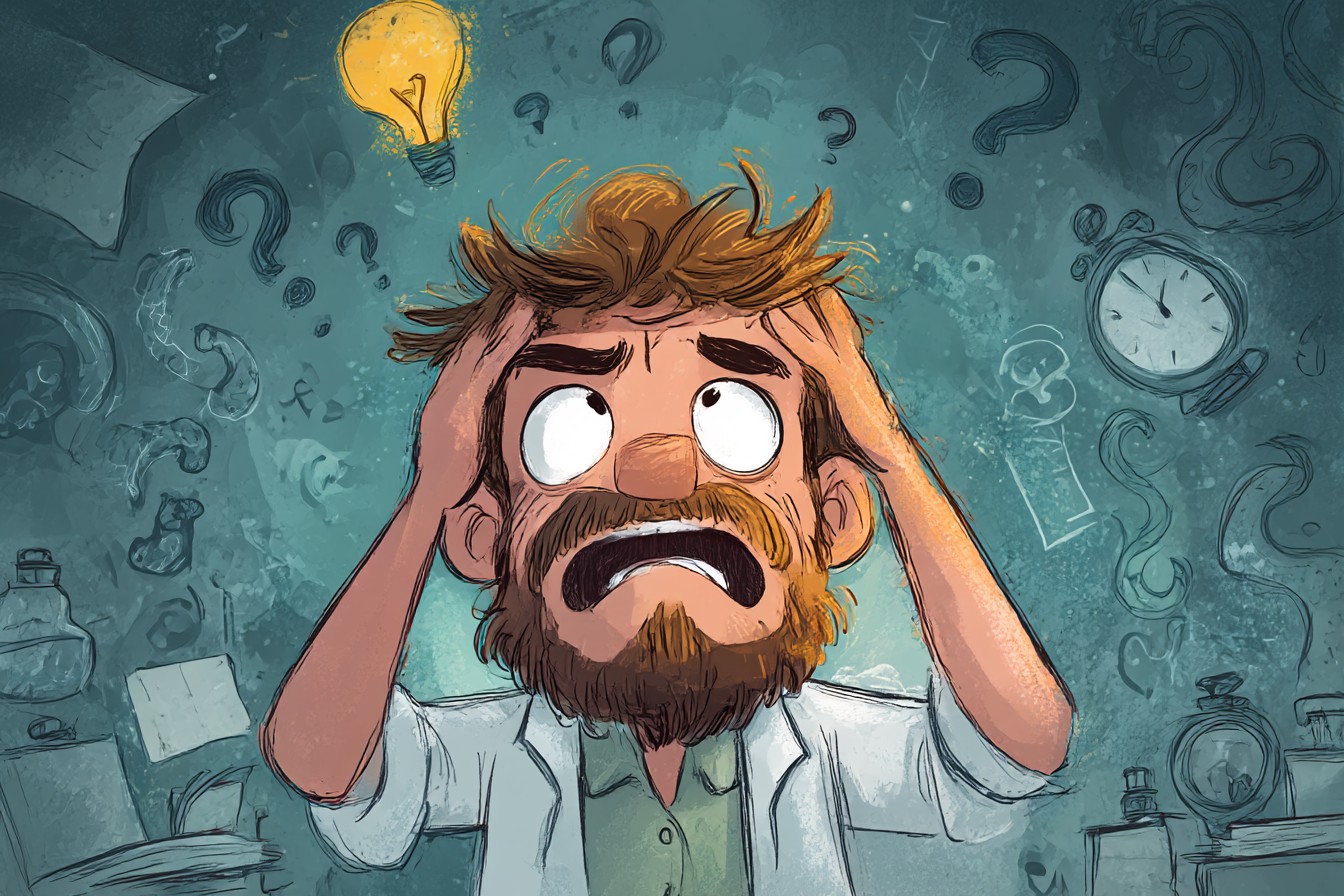
Full disclosure: it began with me standing in front of my open refrigerator at 3AM. I was holding my credit card bill and wondering how I’d ever gotten to the point where I couldn’t explain half my purchases to my boyfriend.
How did I make enough decisions that eventually added up to this? Answers found in spreadsheet form after the jump. Okay, so yeah.
Scientists. Even when faced with the glaring error that was my life choices, I pulled out a notebook. Well, a laptop.
Same thing. What do you do with a problem? You break it down into data points.
You look for patterns. So I made a giant database cataloging all my dumb decisions over the last ten years, and then I tried to build an equation that could predict when my next one would occur. Mei found me three days later, surrounded by printouts and notebook crumbs, hair sprayed at ninety degree angles to my head, ranting about regressions.
“Jamie,” she said gently, navigating the ecosystem of scatterplots littering our apartment floor, “are youuu okay?”
“I’ve got eighteen variables that strongly correlate with my decision-making abilities,” I explained without looking up from my screen. “Time of day is one of them. There’s about a 19% chance I’ll make a bad decision at any given moment.
But did you know there’s a 62% increased chance that decision will be life ruining if it happens between 1 and 4AM?” I thrust the spreadsheet toward her. “Look at these coefficients, they DO NOT LIE.”
She sighed, sinking down next to me on the floor. Mei approaches my workspaces with the weary respect usually reserved for natural disasters.
“You color-coded your mistakes.”

“Yellow means money-related, pink is personal, teal is career.” I waved a hand toward my verbose title slide. “And since I apparently enjoy punishing myself multiple ways at once, orange is when I blow all three at once.” She winced at a heavily annotated section of the spreadsheet labeled ‘spring 2018’. “Wow.
Spring of 2018 was a weird time for me.”
Hey, buddy-assessor: yes, I realize this project was built on a vague assumption that my life could be meaningfully summarized by my worst decisions. But believe it or not, that’s sort of how science works. There’s a whole field of study dedicated to decision-making!
Except most of them don’t track their bad choices using labels like “That Time I Tried to Make Kombucha And Forgot It Existenced” and “When I Thought Drinking Less Coffee Would Cure My Anxiety”. Hours became days, and days became weeks. My original model went through roughly seventeen iterations before Josh sat on my laptop and informed me he would no longer facilitate my science experiments until I slept because “scientist’s gotta rest too, you mad boifoggle.”
Iteration seventeen wasn’t perfect, but it was functional.
I fed it data from the last ten years of my life and found, triumphantly, that it was about 81% accurate in predicting things I later regretted doing. Of course, when I used the algorithm to predict forward, it warned me I would make another regrettable decision every nine days for the rest of my life. “Um.” I frowned at the calculator.
“That can’t be right. The margins of error here are totally going to even out.”
So either my brain had birthed a lie detector that could map out human stupidity patterns with frightening accuracy (COME GET ME, PSYCHOLOGY DEPARTMENTS OF THE WORLD, I HAVE FEELINGS BUT NO SCHOLARLY JOURNALS TO OFFER YOU), or I was mathematically doomed to continue making the same bad choices every nine days until I died. Neither of these options sat particularly well with me.
So I dove back in. This time, I tracked the decisions alongside possible triggers. Not just time of day, but weather patterns, assignment deadlines, erratic sleeping schedules.
Emotional variables. Latte calories. How many times I hung out with my band friends versus my ‘work friends’ versus, uh, Josh-related adrenaline surges.
I turned my apartment into a ground floor science experiment and rigged my living room with noise sensors so I could record light levels at wakeup time. I started a food journal. I made myself a scale, ranked 1-10, to measure what I was grandly calling my “impulse determination” levels—I dribbled an arbitrary value between “interestingly curious about something” and “potentially liable for medical bills”.
And you know what happened? I found something. Really bad decisions didn’t happen at random.
My impulsivity had triggers, and by tracking them, I could anticipate when I was probably going to do something stupid. Sleep deprivation plus looming deadlines was a given. But here’s something else I learned: visiting certain bookstores increased my likelihood of making financial decisions I’d regret by 39%.
My decision-making abilities took a sharp decline when the temperature exceeded 24 degrees Celsius. Cafes with armchair seating were dangerous, as was hopping on any foreign public transit system while nourished only by caffeine. It was Tuesday when I explained these findings to my (completely unwilling) test subjects.
“Essentially,” Aditya said after Mei and Josh had both stared at me for several minutes, reading charts and Rapidly Skimming Through Data Sets Respectively, “you’ve created a mathematical model of yourself being stupid.”
“I know!” I exclaimed, tapping on my laptop. “Isn’t it great? These R values are ugh.”
“The thing is,” Josh said, brow raised as he pulled his own phone from his pocket.
“It kinda works.”
“It works too well?” I countered. Mei raised an abstracted finger, pausing him as she sorted through stacks of highlighted printouts. “Last Tuesday it predicted I would make a regretted electronic equipment-related decision,” I continued, swiping through calendar notifications on my phone.
“And then I bought myself noise-cancelling headphones.”
“What if you knew it was gonna tell you that, so you made that decision?” Josh asked. “I considered that,” I told him. “Hence the control days where I don’t check.
I still hit alarmingly high numbers whether I know the prediction or not.”
“This is so quintessentially you, J.” Mei closed her notebook. “You used your own impulsivity to quantify your impulsivity.”
She wasn’t wrong. Part of me worried that trying to analyze my bad decisions using my inherently obsessive need to track small patterns was…
maybe actually a bad decision. Chew on that, future Jamie. After two months of collecting data and nearly deleting my laptop in a fervor of self-loathing, I understood my motivations far better than I understood my actions.
Sure, I built what I lovingly referred to as a “psychometric decision-driver model” to understand what variables influenced what choices I made. But it also taught me what I was looking to gain when I made decisions. Did I want to feel inspired?
Avoid anxiety? Please other people? About half the time, I was simply rushing toward an outcome.
Impatient with the process. 37% of the decisions I regretted later were made because I wanted to reach a particular destination as fast as possible, and another 26% were made because I knew the stakes of waiting were greater than the stakes of acting, and I just rolled the dice. The rest?
I liked to learn new things, damn it. Too much. Call it the “what happens if” curse.
I made decisions because I was curious about something and didn’t adequately consider whether the answer was worth knowing. (The Great Cold Sandals Experiment of 2018 is one of these. Also why I took half of my chemistry classes while somehow actively sleep deprived.)
By month three, I had built myself a lie detector that actually worked. I had categorized my decision-making tendencies into graphable, chartable bytes of data that allowed me to predict with roughly 86% accuracy when I was going to make another decision I’d regret. I built a custom app that alerted me when I was about to make bad decisions: “Jamie will make a decision she may regret within the next 6 hours” and “WARNING: You have a 59% chance of saying ‘fuck it’ and making a decision”.
It sorta worked, too. I avoided at least three dumb choices in the two weeks I spent anxiously tracking my behavior. I didn’t buy myself those fancy schmancy headphones Amazon kept recommending during one of my awake-at-midnight phases.
I didn’t agree to go out with friends the night before what would’ve been the longest red-eye flight of my life. I didn’t completely restructure my entire work process at 2AM because my phone reminded me that “you make bad career decisions when you’re too tired to sleep, Jamie.”
But then it started predicting good decisions, too. “You have a 92% chance of making successful work-related decisions right now,” my phone notified me during my lunch break on a Wednesday.
“There’s a 63% chance you’ll have a positive social interaction if you talk to X.”
My algorithm was not designed to predict good decisions. It was designed to alert me when I was about to make bad ones. And yet…
I realized, about three revelatory predictions in, that what helped me make bad decisions also gave me the drive to do wildly successful things. All those hours spent raging against the clock were part of why I was able to build a career out of problem-solving. My refusal to accept that things were done ‘good enough’ was why I ended up dropping out of grad school to work in the first place.
I was stubborn. Yes, sometimes that got me in trouble. But it also allowed me to draw connections few other people were brave enough to see.
Three months. I’d spent the better half of three months analyzing myself into a math equation that could predict my behaviors. And the big takeaway?
The things that pushed me to do my best work were, more often than not, the same things that could lead me to do something stupid. I explained my findings, all 89.7 slides of them, to Josh over drinks. “So basically,” he said when I was done scrolling through proofs of my statistically significant revelations, “your unified theory of bad decision-making is that you’re good at some things and bad at others, and they balance each other out.”
“Soooo…yeah?” I sighed.
“But it’s quantified with actual scientific numbers now.”
He snorted. “Only you would spend three months making a calculus model just to realize you’re human.”
“I know it sucks that I’m human,” I said, offended. “But at least now I KNOW WHEN I’M BEING HUMAN.”
He grinned.
“So what are you going to do with that knowledge?”
That was a question with far fewer answers than I’d anticipated.
I could continue running my life like this, programming myself to avoid bad decisions. But some of the things I was most proud of taking chances on would’ve been flagged by my algorithm as “flagrant mistakes.”
So I decided to take my own damn advice.
I kept my alarm system in place for the decisions that truly mattered—I still get reminders whenaphones happen to browse Amazon in my sleep—but I built in failsafes. Deliberate opportunities to make bad decisions and prove my model wrong. Because let’s face it: the only way to really understand yourself is to sometimes… mess up.

0 Comments